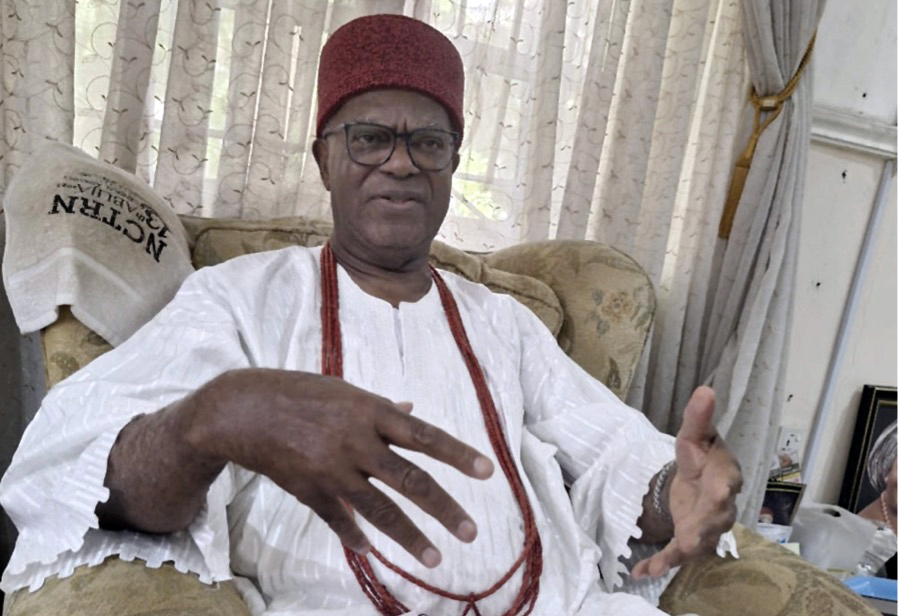
By Chidi Nnadi and Obinna Odogwu Today, His Royal Majesty, Igwe Alfred Nnaemeka Achebe (Agbogidi), turned 85 years. Today too, he is 24 years on the ancient throne of Onitsha, Anambra State. At 85, the Agbogidi has seen it all. He has seen Onitsha as a colonial river port, Biafran stronghold, post-civil war trading behemoth, and the 21st Century sprawling commercial city wrestling with its own growth. In this special interview designed to coincide with Igwe Achebe’s 85th birthday and 24th anniversary on the throne, he spoke frankly and candidly. Igwe Achebe spoke of his early years and growing up, his parents, family, education abroad, the making of the Obi of Onitsha traditional stool, the rituals, IPOB sit-at-home order in Southeast, Ohanaeze Ndigbo’s ban of Ezigbo title in the Diaspora, the state of the economy, his joy and regrets, among others. This is not merely an interview with a king. It is a conversation revealing Onitsha before the British Union Jack came down and the Onitsha that is charting its place in Nigeria’s next century. It is explosive, insightful and revealing. Your Royal Majesty, you were 19 years old at Nigeria’s independence. What are the outstanding memories you still remember about Onitsha before and immediately after independence? I will start by saying that 1960 was memorable for me because that was the year I took my school certificate examination in Owerri. It was a year of independence. Onitsha was at that time a happy, commercial, and educational city. There was a bit of politics also. NCNC (National Council of Nigeria and the Cameroons) was, of course, very much in control then. The city was very clean and we had sanitary inspectors that would go from house to house. At that time, if you had a broken pot containing water and mosquitoes breed in it, you’re taken to the Local Government and fined. So, everybody kept discipline of cleanliness. Onitsha was a very happy city. I was particularly impressed as a young boy growing up and as a grown man thereafter. New Market, Onitsha was lined by bookshops. Ordering books from abroad, particularly England, at Onitsha was easy. And what were those books for? They were to support people studying by correspondence, taking correspondence courses from British institutions for O’Levels and A’ Levels. A’ Levels were called Inter. So, you have Inter LL.B, Inter B.A, intermediate degree commercial subjects like RSA, HND and so on. There was quest for education and there were study centres. Traders do their business in the market, and at the end of the day, they go to the study centres for lectures. I was fortunate to attend government secondary school. The government and Christian secondary schools were not enough to satisfy the people’s thirst for education. Private secondary schools came up in Onitsha – New Bethel College, African College that became Our Lady’s High School, Metropolitan College, Washington Memorial, Etukokwu Memorial College, Prince Institute, the famous Dennis Memorial and so forth. And I believe at that time, Onitsha probably had more private secondary schools than maybe any other city, including Lagos. Many who became Army Generals, Lai Mohammed, former Governor of Kogi State, Chris Garba came to Onitsha to do secondary school and then went on to do whatever they wanted. That was Onitsha then. People worked hard, and the entertainment was cinema. There were night clubs for those who could afford them. Then on Sundays, there were usually football matches. We had Odoakpu vs Fegge etcetera, etcetera. Those were the entertainment then; and people were happy. On Monday they go back to work. So that was Onitsha for me. People like Cardinal Rex Lawson started his career here, playing at night clubs and a few other musicians. Onitsha was a bubbling city, a happy city and a city of opportunities, whether educational, entertainments that I just mentioned. C. T. Onyekwelu had the first recording studio in Onitsha, which was the first inbWest Africa and at least in Nigeria. That was Onitsha for me in those days. In those days, it appeared that the Igbo did not focus in schooling as most of young were trading apprentice (Igba boi). What was it like in Onitsha then? Well, some went to school and other learnt trading. However, the apprentice trading was a big thing. There was no question about that. We lived in the waterside and we had traders that were tenants. Our tenants were mainly from Umuoji. So, the first tenant brings his relative and trains that one, then start a business for him after the training. Often times, the boss moves out of our compound to a more luxurious accommodation and leave that place for his brother or cousin that he had trained. And that one would trains another person. However, the quest for education was also on. As I said earlier, traders would close markets at 5 o’clock and go to the study centres to receive adult education. Talking about the apprentice system, Onitsha, Aba, Nnewi where popular; those trained there branched off to other places like Warri, Lagos and so on. You may get business card and the company’s head office was in Onitsha Main Market, with branches in Lagos, Warri or elsewhere. What can you recall about your parents and Onitsha as a community. What values were instilled in you that are still relevant today? I have to say that my parents were the bedrock of my foundation in life; for myself and my siblings. We were nine children – four boys and five girls. I’m the oldest; and then came the five girls before the three boys. That was basically the structure of my family. My parents were very loving and also very disciplined; and they inculcated that in us. My parents were made for each. It is true because we were told that my mother was betrothed to my father before she was born because my two grandfathers, paternal and maternal, were friends had business transactions. They were honest to each other. My maternal grandfather was impressed with my paternal grandfather and he said to him, “I will give you a wife;” symbolically, that my family will give a wife to your family. The traditional ceremony was done maybe when my mother was 16 or 17 years; and then my father sent her off to finish school at St. Monica’s, Ogbunike where she learnt dressmaking, housekeeping, and all of that. When she finished at St. Monica’s, she went to Emekuku to further her studies. She got married at 20 and had me at 21. So, they were life partners. We never saw them quarrel. We knew that there were disagreements, but they managed it by themselves and they didn’t let it affect us. Something happened. My father had a career in UAC. At 40, he decided to retire and start his own private business. He went into rubber and timber business in Benin, which was a big thing at that time; and my maternal uncle had just returned as a lawyer based in Benin. They put their resources together. My father was coming back from Benin to Onitsha to see us, he came once a month. He had a motor accident at Agbor and his back was broken. He was lucky because many people died in that accident. We stayed in Agbor hospital for six to eight months. He couldn’t move and his business went down. Everything invested was gone. He returned to Onitsha and our mother became the breadwinner of the family. She was a dressmaker and was also trading. So, we learnt from our mother how to work hard from the beginning. From primary school, I was earning a living. I would break firewood, place them on the wall and then people came and bought. I did that after school. On Saturdays, we went to Fegge. Fegge was then under construction. I carried blocks for the construction work. They paid us five shillings. It was a loving family; strongly Catholic. My parents were brought up in Catholic tradition. Education was very important to them, and discipline also, but in a loving manner. We could make jokes with our parents. We could play, but if we did something wrong, we would not be spared. At that time, I could cook everything and I can still cook. At that time, we peeled cassava, soaked it in water for fermentation and then sieve it. It was very normal for us. You said you have female siblings. Why were they not the ones doing that? We did it together. That was the fun. It was me and then the five girls. I was brought up just like the girls. We were brought up together. We were doing it together. On Saturdays, I would wash clothes for all my siblings and my mother; and not my father. My sister did it for my father. There was a reason for that. So that was our family life. Where are your other siblings? The one next to me is now in America with her children. The next two are late; but they left seven children each. And we brought up all the children. They are all graduates and are doing well in various professions. The next two women are in Lagos with their families. Then the next two boys are in Onitsha here. The youngest is in America. You have talked about your family upbringing. What about the community? How did the Onitsha shape your life? The community was part of it, seriously, but in a very interesting way. We lived at Williams Street with a mixture of people from various towns and communities; even from outside. There wad Pa Nwokedi of Nwokedi Street, just a walking distance, from Nnewi; we had the Cole, Wenfo, and so on. The Coles were from Sierra Leone; Wenfo from Ghana. We had the Ogaluonyes from Omambala side, and so on and so forth. It was a blend of both Onitsha people and non-Onitsha people. We actually formed a community and had our own music group. Every village had its own music group. We worked together. We had the Holmes. Holmes was Roman, but he left his family behind. So, we all grew up together, but standards were different. Some of them didn’t go to school enough; they dropped out early, but our parents kept us focused. That wisened me up because you could see the world around you. We had the Ameye family from Igala. Opposite us was Coker. Coker was Sierra Leone. The father of the wife was Sir Louis Mbanefo. We had a community that was alive. Even when I came back as Obi of Onitsha in 2002, the Olieri community was still alive. Prof. Nwokedi was the son of Pa Nwokedi, older than me. He was then the head of the group. He has passed on now. Could you share with us your school days at Stanford and Columbia? How did that shape your life for the corporate world? What lessons did you learn under this period that prepared you for the traditional leadership? Stanford, Columbia; West Coast, East Coast. They are completely different environments. But that is the general environment; the cultures from people. California is relaxed and beautiful. You could go on excursions and the pace of life is easier, but they worked hard. Northern California is a base for the Silicon Valley. So, Google and all these technology were all developed there. University was also beautiful and easy to get along. Columbia is in New York. New York City is big. And everybody is in a hurry; more impersonal than California, but the institutions are very much the same. You have to work hard. You are immersed in knowledge. All you have to do is to work hard to acquire that knowledge so that knowledge stays with you. The opportunity to learn is infinite in both places. You are given study works to do. You come back to class on Monday, the lecturer hasn’t even discussed the work he gave to you to read and he gives you a test on it to prove that you read it. Every test adds up to your final degree; whether it’s a daily test or weekly test. Two points, five points and all that. It’s a kind of continuous assessment. Life in California was easy for me because I had a scholarship; full scholarship. I even took up a part-time job to earn money to send to my siblings at home. By the time we got to Columbia, the Nigeria-Biafra Civil war had started and I did have scholarship for my MBA. I saved up some money, but it didn’t go too far. There again, the university came to my help, to support me with tuition. I had to work to get my living money. But New York toughened me. California introduced me into the American system. It opened my eyes; but New York toughened me. You have to be tough to survive in New York. And today, New York is my favourite city in America. Preparation for life was in two stages. From Nigeria, I was lucky to start at the easy pedestal to California; and then scale up to the tough one, New York. And I think all of them combined. The American system, like I said, pushes you to your limits. It is up to you to be what you want to be. And that is what has driven my life till today. In my jobs I set my goals and did my best to achieve them. As Obi of Onitsha, I set my goals and do my best to achieve them. I was fortunate to have gone to school then. It was a privilege. The only thing I miss, having gone to school in America, is that all my friends and contacts that you normally make in school were those I had in secondary school. Not going to school in Nigeria, my scope was not broadened in terms of friendships and all that. But I had to build that up from my career and my other connections – social connections and all that. You said that New York toughness you. Is it about strength or what? Are you really tough? New York makes you bold. To start with, the average travel to work in New York is one hour. You travel mostly by public transport. But if you drive, to park your car, you have to pay a lot of money. In the morning, everybody is rushing to get into the underground or the bus. If you say good morning to somebody in New York, they’ll say what are you talking about? What’s good about it? Get on the bus. Get on the train. Get to your office. People eat their breakfast walking on the street because there’s no time to sit down. There’s no time for that. You talk on the phone as you are walking, eating and cutting deals. That is New York for you. Your Majesty, you studied in America. You came back after your studies. These day, we send our children abroad for studies and they don’t come back. What is the problem? The problem is Nigeria. I went to America with clear intention of getting sound education. My academic objective kept changing. America also was helpful for that. I wanted to read Medicine. I changed my mind; I didn’t want to read Medicine. And then I took a degree in Chemistry. The option then was to go and do a PhD in Chemistry. I got admission for that, but I changed my mind again. I wanted something practical rather than being a teacher. If you are with PhD in Nigeria, you could go and teach. So, I wanted to do Pharmacy, but the cost of conversion in terms of academic years was much. I was exposed to an MBA opportunity. I went to Stanford Business School and spoke to advisers there. My eyes were opened and I said I’m going to go in for an MBA. I ended up with that, but all with the intention of coming back to Nigeria. And I came back to Nigeria. I had a job. My bosom friend; my classmate, everything from primary school to secondary school, read Medicine, came back to Ibadan. Coming back with his high qualification, there was ethnicity; there was a conflict between American degree and British degree; they said that American degree was useless and. They already had two children. I don’t know how many years he spent and he returned to America. Immediately, Columbia University grabbed him as a professor; made him head of plastic surgery and today, he is retired, but the American Association of Plastic Surgeons has an annual lecture in his honour. Nigeria at a point was not receiving people sufficiently. The economy was changing; job opportunities were not on merit. So, as people came back, they returned abroad. With that, some didn’t venture into returning. Now, it is not us anymore because we are all retired. It’s our children. The downside of it is that when they retire in America, they are longing to be back home. Then, the re-entry point becomes even higher. There is a series going on now on the Onitsha people in the American Diaspora. It’s a six-part series. One of our sons has been going around talking to people on how they came home, why they came home, how come they didn’t go home and all that. So, all the nuances came out. But for our people, many of them are now home on a regular basis. Somebody is taking Ozo title in Onitsha today and some people travelled all the way from America to come and participate. They will stay for a few days and they go back to America again.
The Igwe Alfred Achebe exclusive: My 2 near death experiences – Obi of Onitsha